
Introduction: What Is Off-Page SEO?
When we talk about SEO, most people first focus on on-page SEO: content, titles, and headings. But a complete SEO strategy only succeeds when off-page SEO is taken seriously too. Off-page SEO covers all the activities you do outside your website to improve its ranking, authority, and reputation in the eyes of search engines.
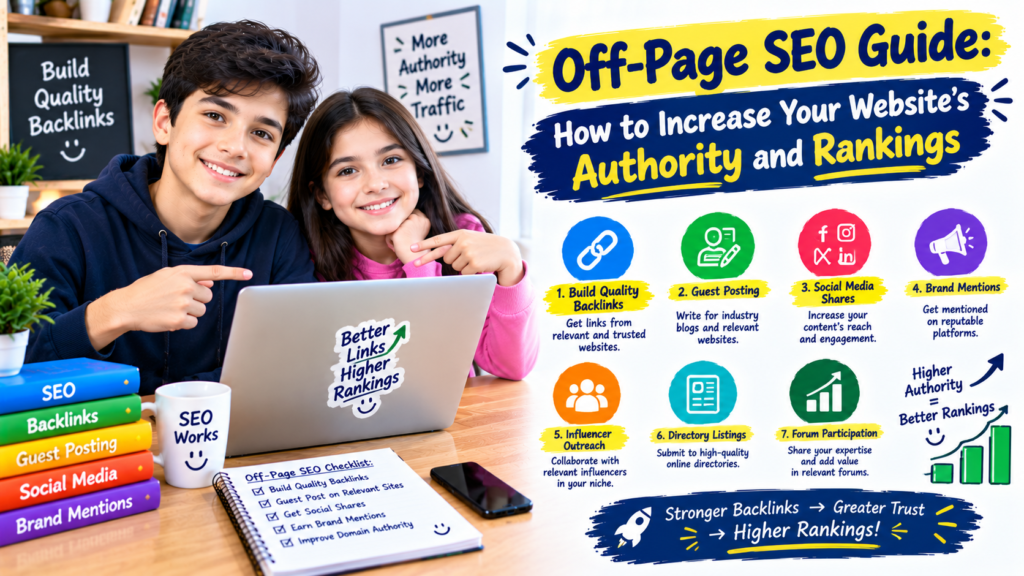
Off-Page SEO Guide explains how to improve your website’s authority, reputation, and search engine visibility through activities outside your website. These activities include quality backlink building, guest posting, social media promotion, brand mentions, and influencer outreach. A strong off-page SEO strategy helps build trust and improve your website’s online presence.
Put simply, on-page SEO tells the world how good your website is, while off-page SEO shows what the rest of the internet thinks about it. When Google ranks a website, it doesn’t only look at the content. It also looks at how many other trustworthy websites reference it, how much people share it on social media, and what its overall online reputation is likehttps://incomehube.com/off-page-seo-guide-how-to-increase-your-websites-authority-and-rankings/
.https://www.youtube.com/watch?v=xFHloJgXBlE
Backlinks are the biggest part of off-page SEO, but it also includes social media marketing, influencer outreach, brand mentions, and online reputation management. In this guide, we’ll go through every important aspect of off-page SEO in detail so you can effectively improve both your website’s authority and its ranking.
What Are Backlinks and Why Do They Matter?
A backlink is a link that goes from one website to another. When website A links to website B, that becomes a backlink for website B. Google treats backlinks as a “vote of confidence.” The more quality websites link to you, the more Google believes your site is trustworthy, authoritative, and valuable.
This concept comes from Google’s original PageRank algorithm, which assumed that if an important website links to another website, that other website must have some value too. Even today, with some evolution, backlinks remain one of the most important ranking factors.
However, the number of backlinks alone doesn’t matter. Google is now very sophisticated and also analyzes the quality, relevance, and source of backlinks. A single backlink from a high-authority, relevant website can be more valuable than a hundred backlinks from low-quality, irrelevant websites.
Types of Backlinks
Backlinks can mainly be divided into two categories: Dofollow and Nofollow.
Dofollow backlinks pass “link equity” or “link juice” to search engines. These backlinks directly help improve your website’s authority and ranking.
Nofollow backlinks carry a special HTML attribute that tells search engines not to follow the link and not to pass any ranking value through it. They are usually used for paid links, comments, or user-generated content. Although they don’t directly help rankings, they can bring referral traffic and increase brand visibility.
How to Identify Quality Backlinks
To build a good off-page SEO strategy, you need to understand which backlinks are high quality.
- Domain Authority: Check the overall domain authority or domain rating of the website giving you the backlink. Backlinks from higher-authority websites are more valuable.
- Relevance: The website linking to you should be relevant to your niche or topic. If you run a fitness blog and get a backlink from an automobile website, it won’t be worth as much as a backlink from another fitness or health website.
- Traffic: The organic traffic of that website is also an important factor. A link from a high-traffic website is more beneficial than one from a low-traffic website, because it can also send you referral traffic.
- Placement: Where the link is placed matters too. A contextual link inside the content is considered more valuable than a link in the footer or sidebar.
- Anchor Text: The clickable text of a link is called anchor text. Natural and varied anchor texts are considered good, while over-optimized, keyword-stuffed anchor texts can look suspicious.
Effective Ways to Build Backlinks
Now let’s look at some practical strategies for building quality backlinks to your website.
Create Linkable Content
The most natural and sustainable approach is to create content so good that people want to link to it themselves. This is also called “link bait” or “linkable assets.” It can take several forms:
- Original research and data studies, where you run your own surveys or analysis and present unique statistics, attract a lot of links because other bloggers and journalists use them as references.
- Comprehensive guides and tutorials that cover a topic in so much detail that people keep coming back to reference them are also very effective link magnets.
- Infographics are visually appealing and easy to share, so they can also generate many backlinks.
- Free tools or calculators that are genuinely useful to users get recommended on other people’s websites too.
Guest Posting
Guest posting is a popular and effective off-page SEO strategy. You write content for other relevant websites and, in return, get a link to your website, usually in the author bio or within the content.
Keep a few important things in mind when guest posting. Only target high-quality, relevant websites, not spammy or low-authority sites. The content should be genuinely valuable, not thin content written just to get a link. Follow each website’s guidelines and tailor the content to their audience.
Guest posting is useful not just for backlinks, but also for reaching a new audience, establishing your expertise, and networking.
Broken Link Building
This is a smart technique where you look for broken links (links that no longer work) on other relevant websites. When you find one, you contact the site owner, tell them their link is broken, and suggest your own relevant content as a replacement.
This technique works because you are genuinely helping the website owner (by fixing their broken link), and in return your chances of getting a valuable backlink go up.
Skyscraper Technique
In the skyscraper technique, you first find the most popular, most linked-to content in your niche. Then you create a better, more comprehensive, and more up-to-date version of it. Next, you contact the websites that linked to the original content and let them know you have a better resource they can consider.
This technique takes a lot of effort, but if done properly, it is very effective at earning high-quality backlinks.
Resource Page Link Building
Many websites have “resource pages” where they curate useful links for their niche. You can find these resource pages and suggest your relevant content to the site owners so they include it in their resource list.
HARO and Journalist Outreach
Services like HARO (Help A Reporter Out) connect journalists and experts. Journalists ask for quotes or insights for their articles, and if you give them a good response, you may get a mention with a backlink in those articles. This is a great way to get backlinks from high-authority news websites.
Competitor Backlink Analysis
Analyzing your competitors’ backlink profiles is another smart strategy. Use tools like Ahrefs or SEMrush to see where your competitors are getting backlinks from. If a website links to your competitor, it may link to you too, provided your content is relevant and better.
Local Directories and Business Listings
If you have a local business, list it in local directories, chamber of commerce websites, and industry-specific directories. This provides backlinks and is also very beneficial for local SEO.
Backlink Mistakes to Avoid
Some mistakes in off-page SEO can harm your website instead of helping it.
- Buying Paid Links: Google’s guidelines clearly prohibit buying or selling links just to improve rankings. If Google finds out you are using paid links, your website can receive a manual penalty.
- Link Farms and PBNs: Private Blog Networks (PBNs) and link farms, where many low-quality websites are created only to give backlinks, are very risky. Google detects and penalizes these networks easily.
- Links from Irrelevant Websites: Getting links from websites that are completely unrelated to your niche can look suspicious and doesn’t add much value either.
- Over-Optimized Anchor Text: If all your backlinks use exactly the same keyword as anchor text, it can look unnatural to Google and raise the risk of a penalty.
- Low-Quality Directory Submissions: Submitting your website to lots of low-quality, spammy directories that provide no real value is a waste of time and can sometimes be harmful.
Social Media and Off-Page SEO
Social media signals are not directly part of Google’s ranking algorithm, but they affect SEO quite a bit indirectly.
When you share your content on social media platforms like Facebook, Twitter (X), LinkedIn, or Instagram, its visibility increases. More people see the content, which also raises the chances of organic backlinks, since someone who finds the content interesting may link to it from their own website or blog.
Social media profiles can also rank in search results themselves, especially for brand name searches. So keeping your social media profiles complete and active is a small but important off-page SEO factor.
Engagement on social media, such as likes, shares, and comments, also helps build brand awareness and trust, which strengthens your website’s overall online presence in the long run.
Some Social Media Strategy Tips
Share your new content on social media regularly, and don’t just post promotional material. Genuinely engage with your audience too. Customize content formats for different platforms, such as a professional tone for LinkedIn and visual-heavy content for Instagram.
Collaborate with influencers and industry experts, because your content can reach more people through them, increasing the chances of both backlinks and mentions.
Brand Mentions and Unlinked Mentions
A brand mention is when a website mentions your brand or business name, whether or not it includes a backlink. Google also treats these mentions as a trust signal, especially when they appear on high-quality, relevant websites.
Often, a website mentions your brand name but doesn’t link to you. This is called an “unlinked mention.” You can track these unlinked mentions (using Google Alerts or specialized tools) and contact the website owner to request that they turn the mention into a link.
This strategy is relatively easy because the website has already mentioned you, so convincing them to add a link is often simple.
Online Reputation Management
Off-page SEO isn’t limited to backlinks. Your overall online reputation is part of it too. Google wants the websites it ranks to be trustworthy and reputable.
- Manage Your Reviews: Regularly monitor your reviews on Google Business Profile, Yelp, and other review platforms, and respond to them, whether positive or negative.
- Address Negative Content: If there is negative content about you online, address it professionally and try to balance it out by publishing positive content.
- Build a Consistent Brand Presence: Maintain a consistent presence for your brand everywhere, whether on social media, review sites, or industry forums.
- Prioritize Customer Service: Good customer service directly generates positive reviews and mentions, which indirectly improves your off-page SEO too.
Influencer Outreach and Collaborations
Influencer marketing has become an effective part of off-page SEO. When you collaborate with influencers in your niche, you get the chance to reach their audience, along with backlinks, mentions, and social shares.
When doing influencer outreach, first identify relevant influencers in your niche whose audience matches your target customers. Try to build a genuine relationship with them rather than taking a purely transactional approach.
Collaborations can take several forms: sponsored content, product reviews, guest appearances, or joint webinars. Each collaboration can bring you exposure, credibility, and potentially backlinks.
Forum and Community Participation
Active participation in relevant online forums, such as Reddit, Quora, or niche-specific community forums, can also be part of an off-page SEO strategy.
Giving genuinely helpful answers on these platforms, and sharing your website link where relevant (without being spammy), can bring you referral traffic and occasionally backlinks. But keep in mind that putting your website link in every answer can look spammy and may even get you banned from the community. Take a value-first approach.
Podcast and Video Collaborations
Podcasts and YouTube collaborations are also a growing opportunity for off-page SEO. If you appear as a guest on a popular podcast, your website link is usually included in the episode description, which can become a valuable backlink.
Similarly, YouTube collaborations, such as making joint videos with other creators, help you reach new audiences and generate brand mentions.
Content Distribution for Off-Page SEO
Creating good content isn’t enough. You also need to distribute it properly so that as many people as possible see it and link to it.
Reach your subscribers through email newsletters. Share it in relevant online communities and groups where such content is allowed. Use content syndication platforms like Medium to reach a wider audience, but use canonical tags to avoid duplicate content issues.
Tracking Your Off-Page SEO Progress
It’s important to measure the effectiveness of your off-page SEO so you can see whether your strategy is working.
- Monitor Your Backlink Profile: Use tools like Ahrefs, SEMrush, or Google Search Console to check your backlink profile regularly, and see how many new backlinks you’re getting and which websites they come from.
- Track Domain Authority: Watch the trend of your website’s domain authority or domain rating to see whether your overall authority is improving.
- Analyze Referral Traffic: In Google Analytics, see how much referral traffic your backlinks bring in and which sources are the most valuable.
- Track Brand Mentions: Use Google Alerts or specialized tools to track your brand mentions so you know what people are saying about you online.
- Watch Ranking Trends: Check your target keyword rankings regularly and see whether they are improving alongside your off-page efforts.
Patience in Off-Page SEO
It’s very important to understand that off-page SEO is a slow, gradual process. Building quality backlinks takes time, and their impact doesn’t show up immediately. Google also takes some time to discover new backlinks and reflect their effect in its algorithm.
Trying to take shortcuts, like paid links or spammy tactics, may give some benefit in the short term, but they are very risky in the long term, and your website could face a severe penalty. So focus on ethical, white-hat off-page SEO strategies that deliver sustainable, long-lasting results.
Off-Page SEO and Local Businesses
If you have a local business, such as a restaurant, clinic, or salon, the focus of off-page SEO is a bit different. The most important thing in local off-page SEO is building citations, meaning listing your business name, address, and phone number (NAP) consistently on other websites.
Submit your business to local directories like Justdial, Sulekha, or industry-specific listings, and make sure your information is exactly the same everywhere. Inconsistent NAP information can confuse Google and hurt your local ranking.
Also try to get backlinks from local news websites, community blogs, and local business associations. Sponsoring local events or taking part in community initiatives can also earn you local media coverage and backlinks.
Customer reviews are also a huge part of local off-page SEO. Politely ask your customers for reviews and encourage them to leave them on Google Business Profile, Facebook, and other relevant platforms. More positive reviews not only help rankings but also build trust with new customers.
Off-Page SEO for E-commerce Websites
Off-page SEO for e-commerce websites comes with some unique challenges, because they have many product pages that are difficult to promote individually.
Collecting product reviews and ratings is a very important part of e-commerce off-page SEO. The more genuine reviews you have, the more trust is built, and this indirectly helps SEO too.
Influencer marketing is especially effective for e-commerce. Through product reviews, unboxing videos, or sponsored posts, influencers tell their followers about your products, which brings both brand mentions and backlinks.
Affiliate marketing programs are also a good way to grow your off-page presence. When affiliates promote your products on their websites or blogs, they usually link to your website, which generates backlinks.
Try to get your products featured on comparison websites and “best of” listicle articles, since they provide both high-intent traffic and valuable backlinks.
Off-Page SEO and Content Repurposing
Repurposing the same content into multiple formats is another smart off-page SEO strategy. If you’ve written a detailed blog post, it can also be converted into an infographic, a short video, or a podcast episode.
Each format can be shared on a different platform, giving your content the chance to reach new audiences. For example, an infographic can be shared on Pinterest, a video on YouTube, and a podcast episode on Spotify or Apple Podcasts.
This approach not only increases your content’s reach, but also significantly raises the chances of getting backlinks and mentions from different platforms, since each platform has its own unique audience and sharing behavior.
White-Hat vs. Black-Hat Off-Page SEO
Off-page SEO strategies can be divided into two broad categories: white-hat and black-hat.
White-hat off-page SEO includes all techniques done within Google’s guidelines, such as genuine content marketing, ethical guest posting, and natural link building. These strategies may be slow, but they are sustainable and safe in the long run.
Black-hat off-page SEO includes techniques that violate Google’s guidelines, such as paid links, private blog networks, and automated link building schemes. These techniques can deliver fast results in the short term, but if Google detects them, the website can receive a severe penalty, its rankings can crash completely, or it can even be removed from the index.
Beginners are strongly advised to always focus on white-hat strategies, because short-term shortcuts can prove very costly in the long term.
Off-Page SEO and International Websites
If your website provides content for multiple countries or languages, it’s important to adapt your off-page SEO strategy accordingly.
Try to get backlinks from local, relevant websites in each target country, not just generic English-language websites. Collaborating with local influencers and local media outlets is also very effective for international off-page SEO.
Also consider country-specific social media platforms and forums, since different platforms are popular in different regions. Keep cultural context in mind and customize your outreach and content strategy so that it genuinely resonates with the local audience.
Conclusion
Off-page SEO is as important a part of a website’s overall SEO strategy as on-page or technical SEO. It establishes your website’s authority, trustworthiness, and credibility in the eyes of the internet.
In this guide, we saw how backlinks are built, which strategies are effective, which mistakes to avoid, and how other factors such as social media, brand mentions, and online reputation affect off-page SEO.
To build a successful off-page SEO strategy, consistency, patience, and ethical practices are the most important things. Instead of chasing quick results, create genuinely valuable content, build the right relationships, and take care of your online reputation. Over time, these efforts will significantly improve your website’s ranking, traffic, and overall online presence.