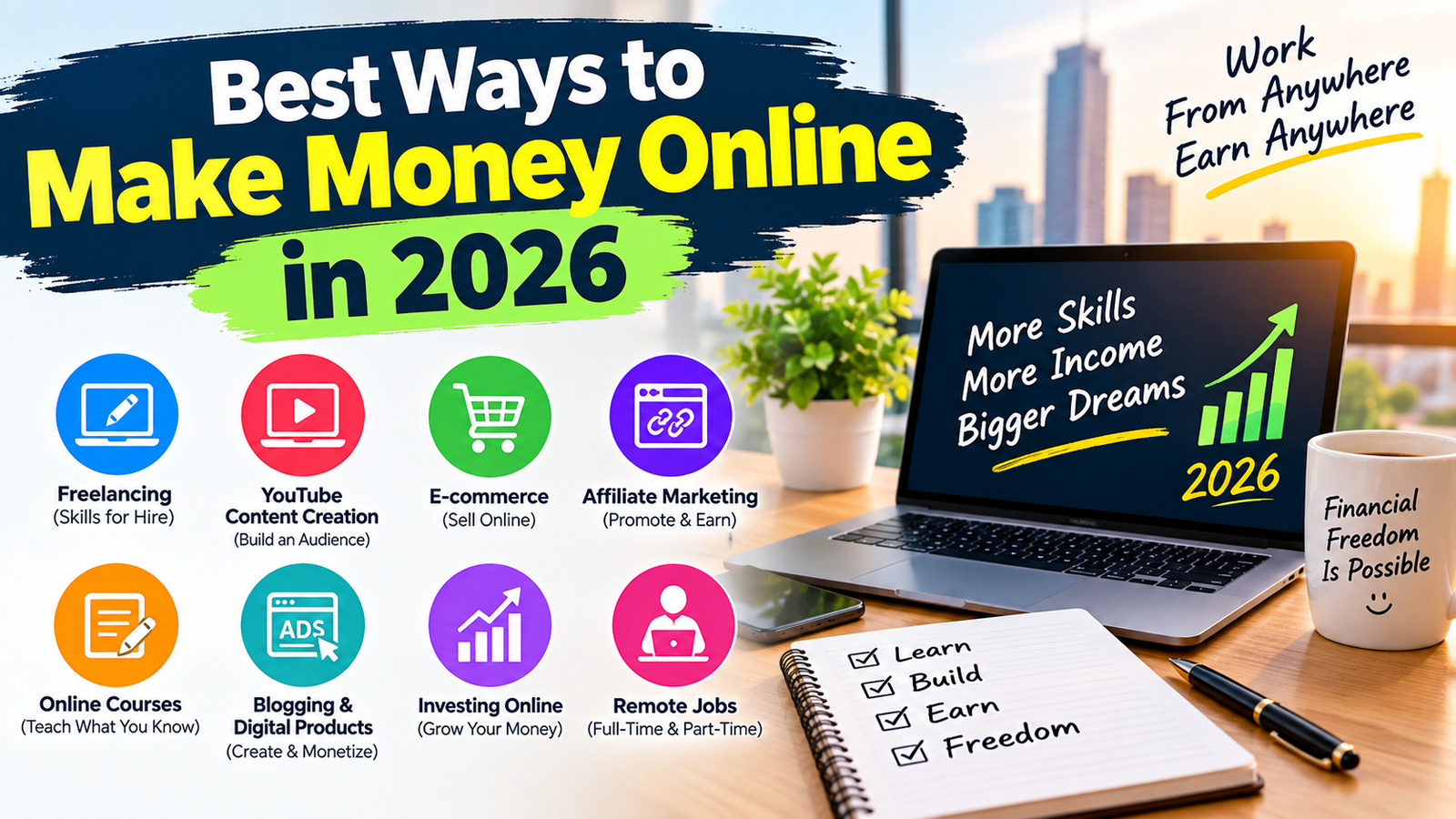
Best Ways to Make Money Online in 2026
Making money online is no longer a niche pursuit. It has become a mainstream part of how millions of people supplement their income or replace a traditional job entirely. But the methods that worked five years ago do not necessarily work the same way today. Search engines have changed how they rank content, social platforms reward different types of videos, artificial intelligence tools have flooded certain markets with low-effort content, and buyers have become more selective about what they trust.
This article is a comprehensive, practical guide to the best ways to make money online in 2026. It covers not just what to do, but how each method actually works, what has changed recently, realistic income expectations, and the common mistakes that stop people from succeeding. The goal is to give a clear, honest picture rather than exaggerated promises, so you can choose a path that actually fits your skills, time, and goals.
Why the Rules Have Changed
Before getting into specific methods, it helps to understand why online income strategies look different now compared to a few years ago.
First, content saturation has increased dramatically. Anyone can now generate a blog post, a product description, or even a video script using AI tools in seconds. This means low-effort content no longer stands out, and platforms have adjusted their algorithms to favor content that demonstrates real experience, expertise, and originality.
Second, audiences have become more skeptical. People have seen enough generic reviews, obviously AI-written articles, and exaggerated income claims that they now actively look for signs of authenticity, such as personal photos, specific numbers, and firsthand experience.
Third, platforms themselves have matured. Search engines, video platforms, and marketplaces all have more sophisticated systems for detecting manipulation, spam, and thin content. Shortcuts that used to work, such as keyword stuffing or mass-producing low-quality videos, are far less effective now and can even get accounts penalized.
These shifts do not mean it is harder to make money online. They mean the bar has moved from “quantity of content” to “quality and specificity.” People who succeed in 2026 are the ones who identify a real need and address it with genuine value, rather than those trying to game a system.
1. Freelance Services
Freelancing remains one of the fastest and most reliable ways to earn online because it does not require building an audience before you can get paid. Businesses of every size continue to outsource work such as writing, graphic design, video editing, web development, bookkeeping, and virtual assistance.
What Has Changed
The freelancers who succeed in 2026 are the ones who specialize rather than offer generic services. Marketing yourself simply as a “writer” puts you in competition with a flooded, low-cost market. Positioning yourself as a “SaaS onboarding email specialist” or “technical documentation writer for fintech startups” makes you far more hireable and allows you to charge significantly higher rates. Clients pay a premium for expertise in a narrow niche because it reduces their risk and saves them time explaining context.
How to Get Started
Getting started usually means building a small portfolio, even from spec work, personal projects, or pro bono work for a local business, and then pitching directly to potential clients rather than waiting for marketplace algorithms to surface your profile. Cold outreach through email or LinkedIn, paired with a clear, specific offer such as “I can rewrite your top three landing pages to improve conversion,” tends to outperform generic marketplace listings where you are competing purely on price.
Realistic Expectations
Beginners typically earn 300 to 800 dollars per month working part-time in the first few months. Freelancers who build a steady client base and refine their niche can earn 2,000 to 8,000 dollars per month or more, depending on the industry and their positioning. High-demand technical skills, such as backend development or conversion copywriting, often command the highest rates.
2. Affiliate Marketing
Affiliate marketing involves promoting other companies’ products or services and earning a commission on any resulting sales. This model has matured significantly, and the days of publishing a thin blog and easily ranking on search engines are largely over.
What Works Now
Success now depends on building genuinely useful content around buyer-intent searches, meaning queries where people are actively comparing products or ready to purchase, rather than just casually researching a topic. Reviews, comparison articles, and “best of” roundups still perform well when they include real testing, screenshots, or firsthand experience, because both readers and search engines increasingly reward authenticity over generic, templated content.
Video content has also become a major driver of affiliate income. Short-form video platforms allow creators to demonstrate products in action and include affiliate links directly, often converting at a higher rate than static blog posts because viewers can see the product being used before deciding to buy.
Patience Is Required
Affiliate marketing takes time to build momentum. It is common for a new site or channel to take four to twelve months before generating consistent income, since results depend on either search engine trust being built over time or an audience growing gradually. Many people quit right before they would have started seeing results, so setting a realistic timeline in advance matters.
Realistic Expectations
Early-stage affiliate marketers often earn very little or nothing for the first few months. Those who stick with it and build authority in a specific niche can eventually earn anywhere from 200 to several thousand dollars per month, with top performers in competitive niches earning far more.
3. Selling Digital Products and Online Courses
Digital products, including ebooks, templates, presets, spreadsheets, and online courses, remain one of the most scalable online income methods because they can be created once and sold repeatedly without additional production cost per sale.
The Key Shift
Generic, broad courses now struggle to sell because free information is widely available, including from AI tools that can answer most basic questions instantly. Whatsells well in 2026 is highly specific, practical content that saves the buyer time or solves a narrow, painful problem. A course titled “How to Use Spreadsheets” will struggle to find buyers, while “Build a Client Invoicing System in Google Sheets in One Afternoon” targets a specific need, a specific buyer, and a specific outcome.
Getting Discovered
Platforms for selling digital products have become more accessible, allowing creators to set up a simple storefront without needing technical skills. The bigger challenge is not building the product itself but getting it in front of the right audience, which usually requires building some kind of following first, whether through short-form video, a newsletter, or a niche blog that establishes credibility before the pitch.
Pricing Strategy
Low-priced products, such as five to twenty dollar ebooks or templates, tend to sell in higher volume and act as an entry point into a brand, while higher-priced courses in the fifty to two hundred dollar range require more trust-building through content, testimonials, and demonstrated expertise before people are willing to buy.
Realistic Expectations
Results are highly variable. Many creators earn under 100 dollars per month from a single digital product, especially early on, while creators with an established audience and multiple products can earn several thousand dollars monthly, particularly when they bundle products or introduce recurring offers.
4. Print on Demand
Print on demand allows sellers to design products such as t-shirts, mugs, and phone cases without holding any inventory. When a customer places an order, the product is printed and shipped by a third party, and the seller keeps the profit margin.
Increased Competition
This model has become more competitive over the past few years, so success now depends heavily on niche selection and design quality rather than simply uploading generic designs and hoping for sales. Sellers who focus on specific communities, such as a particular hobby, profession, or subculture, tend to outperform those targeting broad, oversaturated categories like generic motivational quotes.
Marketing Matters More Than Ever
Simply listing products on a marketplace and waiting is rarely enough anymore. Successful print on demand sellers usually drive traffic through social media content that showcases the design process or the finished product in real use, which builds trust and interest before a purchase decision is made.
Realistic Expectations
Many sellers earn under 50 dollars per month starting out, especially without a marketing plan. Those who find a strong niche and combine it with consistent content marketing can reach several hundred to a few thousand dollars per month.
5. Faceless Content Creation
Faceless content, meaning videos or channels where the creator does not show their face, has grown significantly because it lowers the barrier to entry for people who are camera-shy or simply prefer privacy. Common formats include narrated documentary-style videos, animated explainers, compilation content, and voiceover storytelling.
How Monetization Works
Monetization typically comes from a combination of ad revenue, sponsorships, and affiliate links once a channel reaches sufficient view counts. Because production can be partially automated using text-to-speech tools, stock footage, and editing templates, creators can scale output more easily than traditional on-camera content, though quality and originality still matter significantly for long-term growth and algorithm favor.
Staying Consistent
The most successful faceless channels pick a specific content niche and stay consistent, since algorithms and audiences both favor channels with a clear, recognizable identity over ones that jump between unrelated topics. Consistency in upload schedule also plays a meaningful role in audience retention and algorithmic reach.
Realistic Expectations
Small channels may earn very little for the first several months while building an initial audience. Channels that build a consistent audience of 50,000 or more subscribers can earn anywhere from a few hundred to several thousand dollars per month through ads and sponsorships combined, with sponsorship deals often paying more than ad revenue alone.
6. Remote Freelance and Contract Work
Beyond project-based freelancing, many companies now hire remote contractors for ongoing roles such as customer support, bookkeeping, project coordination, and social media management. These roles offer more income stability than one-off freelance gigs because they typically involve a set number of hours per week at an agreed rate.
Who This Suits
This path suits people who prefer predictable income over the feast-or-famine nature of project-based freelancing or content creation, where income can fluctuate significantly month to month. It also suits people transitioning out of traditional employment who want a similar sense of structure while working remotely.
Finding Opportunities
Building a strong profile on freelance and remote work platforms, along with direct outreach to small businesses that may not have the budget for a full-time hire, tends to produce steady opportunities. Many small business owners are open to part-time remote help but do not know where to find it, which creates an opening for proactive outreach.
Realistic Expectations
Typical earnings range from 500 to 3,000 dollars per month depending on the number of hours committed and the specific role, with specialized skills such as bookkeeping or technical support often commanding higher hourly rates.
7. Coaching and Consulting
For people with established expertise in a field, whether that is marketing, fitness, finance, or software, offering paid coaching or consulting calls has become an increasingly common income stream. This does not require a large audience to start, since even a small, engaged following or a handful of referrals can support a consulting practice.
The Advantage of This Model
The advantage of coaching and consulting is a high per-hour rate compared to most other online income methods, since clients are paying directly for expertise and personalized guidance rather than a mass-produced product. It also tends to build strong word-of-mouth referrals when clients see real results.
Realistic Expectations
Income is highly dependent on expertise and niche, ranging from a few hundred dollars per month for beginners to several thousand for established consultants with a strong reputation and consistent client flow.
8. Online Tutoring and Skill-Based Teaching
Teaching a skill you already have, whether academic, language-based, or technical, remains a steady and often underrated way to earn online. Demand continues for subjects like mathematics, standardized test preparation, coding, and language learning, particularly from students and professionals seeking flexible scheduling.
Why This Still Works
Unlike many content-based income methods, tutoring provides direct, immediate value in a live or recorded format, and word-of-mouth referrals from satisfied students or parents can create a steady stream of new clients without heavy marketing investment.
Realistic Expectations
Hourly rates vary widely by subject and platform, typically ranging from 15 to 60 dollars per hour, with specialized subjects such as advanced mathematics or professional certification exam prep commanding rates on the higher end.
9. Dropshipping and E-commerce
Dropshipping allows sellers to run an online store without holding inventory, since orders are fulfilled directly by a supplier. While the model has become more saturated and competitive than in previous years, it remains viable for sellers who focus on a specific product niche and invest in genuine branding rather than generic, undifferentiated storefronts.
What Separates Success From Failure
The sellers who succeed treat their store like a real brand, with a consistent visual identity, clear product photography, and content marketing that builds trust, rather than treating it as a quick, low-effort side project. Customer service and shipping transparency have also become more important as consumers have grown wary of low-quality dropshipping experiences.
Realistic Expectations
Startup costs are generally low, but profit margins can be thin after accounting for advertising costs. Many stores fail to become profitable, while well-run niche stores with strong branding can generate anywhere from a few hundred to several thousand dollars per month in profit.
10. Selling Stock Photos, Videos, and Audio
Creators with photography, videography, or audio production skills can earn passive income by licensing their work through stock content platforms. While individual sale prices are often modest, a large, well-tagged portfolio can generate a steady stream of small payments over time.
What Sells Well
Content that fills specific, commonly searched needs, such as diverse workplace scenarios, seasonal lifestyle imagery, or royalty-free background music for specific moods, tends to perform better than generic or oversaturated categories like generic sunsets or stock handshake photos.
Realistic Expectations
This tends to be a slower-building income stream, often requiring a large portfolio built over months or years before generating meaningful income, but it can become a reliable passive income source once established.
Comparing the Methods
Each method above involves a different balance of speed, effort, and scalability. Freelancing and remote contract work tend to generate income the fastest since they rely on trading time and skill directly for payment, often producing results within the first few weeks. Affiliate marketing, digital products, and content creation take longer to become profitable, often several months, but offer more scalability once momentum builds, since income is not directly tied to hours worked.
Dropshipping and print on demand sit somewhere in between, offering moderate speed to first sale but requiring ongoing marketing investment to stay profitable. Coaching, consulting, and tutoring offer strong per-hour income but depend on your available time, similar to freelancing.
Common Mistakes to Avoid
A common mistake is trying to pursue several of these methods at once without giving any of them enough focused effort to succeed. Spreading attention across five different income ideas simultaneously usually means none of them receive the consistency needed to gain traction, whether that traction comes from search engine trust, audience growth, or client relationships.
Another mistake is underestimating the time required to see results, particularly for audience-dependent methods like affiliate marketing and content creation. Expecting significant income within the first month often leads to giving up right before momentum would have started building.
A third mistake is copying competitors too closely instead of identifying a genuinely underserved angle. Markets that appear saturated on the surface often still have room for someone who addresses a specific audience or problem that existing content ignores.
Finally, many people neglect to track their numbers, whether that means client acquisition cost, conversion rates, or content performance. Without tracking, it becomes difficult to know what is actually working and what should be dropped, which slows progress considerably.
Building a Realistic Action Plan
Choosing one method and committing to it for a meaningful period, such as three to six months, while tracking results honestly, tends to produce far better outcomes than spreading effort too thin across multiple untested ideas. A practical starting approach looks like this.
Begin by assessing your current skills and available time honestly. Someone with strong writing or design skills and limited time may be better suited to freelancing, while someone with more time but fewer existing skills may benefit from starting with content creation or a digital product, using the learning process itself as content.
Next, choose one method and set a specific, measurable goal for a defined period, such as landing three freelance clients in sixty days or publishing twenty pieces of content in ninety days. Specific goals make it easier to evaluate progress honestly rather than relying on vague impressions.
Finally, review your results at the end of the period and decide whether to continue, adjust your approach, or pivot to a different method based on what the data shows, rather than based on frustration or impatience alone.
The Role of AI Tools in Online Income
No discussion of making money online in 2026 is complete without addressing how artificial intelligence tools fit into the picture. AI has changed almost every method described above, but not in the way many people assume. It has not eliminated the need for human skill and judgment; instead, it has shifted where that skill is most valuable.
For freelancers, AI tools can speed up first drafts, research, and repetitive tasks, but clients increasingly want the human element, meaning strategic judgment, editing for voice and nuance, and accountability for the final result. Freelancers who use AI as a starting point and then apply real expertise on top of it tend to produce better work faster, while those who submit raw AI output without meaningful editing often lose client trust quickly once it becomes obvious.
For content creators and affiliate marketers, AI has made it easier to produce first drafts of articles or video scripts, but it has also flooded the internet with generic, low-effort content. This has made firsthand experience, original photography, and genuine testing far more valuable as differentiators, since these are the elements AI cannot fabricate convincingly. Search engines and audiences alike have become better at recognizing content that lacks real substance behind it.
For digital product creators, AI tools can help with drafting course outlines, generating templates, or producing supporting graphics, which lowers the barrier to creating a first version of a product. However, the products that sell well still require a creator’s unique framework, personal experience, or specific results to stand out from an increasingly crowded market of AI-assisted competitors.
The practical takeaway is that AI tools are best treated as an assistant that handles repetitive or first-draft work, freeing up time to focus on the parts of the process that require genuine expertise, judgment, and originality. Relying on AI entirely, without adding meaningful human value, tends to produce mediocre results that struggle to compete in any of the methods covered in this guide.
Frequently Asked Questions
How much money can I realistically make online in my first month?
For most methods, especially those that depend on building an audience such as affiliate marketing or content creation, the first month typically produces very little income, sometimes none at all. Freelancing and remote contract work tend to produce faster results, sometimes within the first few weeks, because they involve direct exchanges of time and skill for payment rather than waiting for an audience or search engine trust to build.
Do I need money to start making money online?
Many of these methods can be started with little to no upfront investment, particularly freelancing, coaching, and content creation, which mainly require time and existing skills. Methods like dropshipping and paid advertising for digital products typically require some capital for inventory testing or ad spend, so it is worth choosing a method that matches your available resources.
How long does it take to replace a full-time income online?
This varies enormously based on the method, the effort invested, and the niche chosen, but a realistic timeline for most people is somewhere between one and two years of consistent, focused work, not the ninety days often promised in exaggerated marketing claims. Some freelancers and consultants with in-demand skills can reach full-time income faster, sometimes within six months, because their income is tied directly to billable hours rather than audience growth.
Is it better to focus on one income method or try several at once?
Focusing on one method until it becomes consistently profitable is almost always more effective than splitting attention across several unproven ideas simultaneously. Once one income stream is stable, it becomes much easier to add a second one, both because you have more resources and because you better understand what building an online income stream actually requires.
Which method has the lowest barrier to entry?
Freelancing generally has the lowest barrier to entry because it requires no audience, no upfront product creation, and can start generating income as soon as you land a first client. Tutoring and coaching are similarly accessible for people with existing expertise, since they also do not require building a following before earning.
How important is niche selection?
Niche selection is one of the most important decisions across nearly every method described in this guide. A narrow, specific niche makes it easier to stand out, easier to market to a defined audience, and easier to become known as the go-to option for a particular problem, compared to competing broadly against thousands of generalist competitors.
Final Thoughts
Making money online in 2026 is still very achievable, but it requires realistic expectations and consistent effort rather than searching for a shortcut. The methods that work best are the ones that solve a real problem for a real audience, whether that audience is a business needing a specific service, a consumer looking for guidance on a purchase decision, or a student seeking to learn a new skill.
The online income landscape will keep evolving, just as it has over the past several years, but the underlying principle behind every method covered here remains constant: genuine value, delivered consistently to a specific audience, outperforms shortcuts and low-effort tactics every time. Platforms and algorithms will continue to change, but the fundamental need to solve real problems for real people is unlikely to disappear.
Starting with one method, learning it properly, tracking results, and building from there remains the most reliable path to sustainable online income. The barrier to entry has never been lower, but the bar for standing out has never been higher, which means genuine effort, specificity, and patience are now more valuable than ever for anyone serious about building online income in 2026 and beyond.