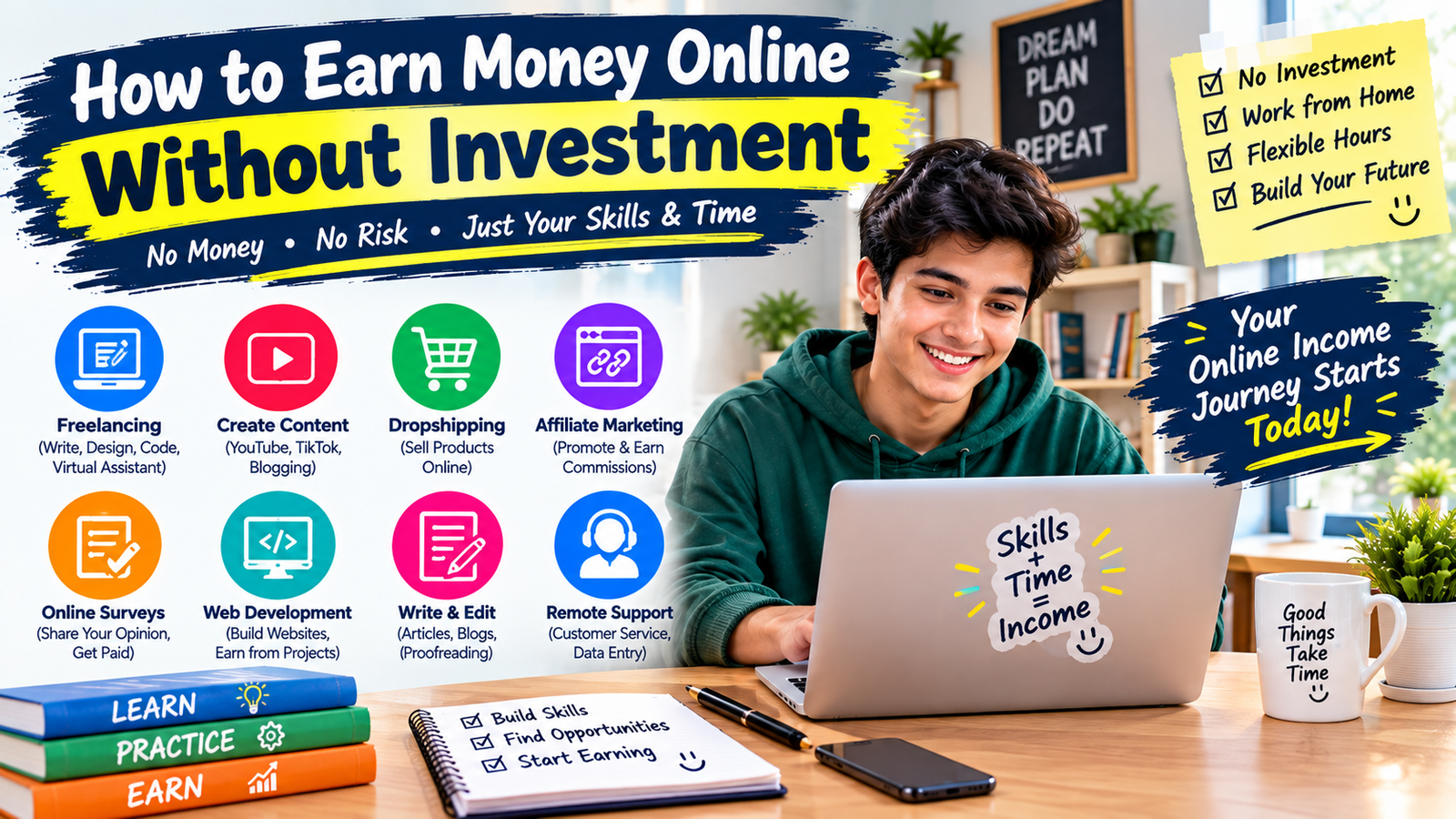
How to Earn Money Online Without Investment
One of the most common questions people ask when exploring online income is whether it is actually possible to start without spending any money upfront. The good news is yes, it is possible, and it remains one of the most practical entry points for people who are cautious about risking money on something unproven, or who simply do not have spare capital to invest. The trade-off is that methods requiring no financial investment almost always require a larger investment of time, effort, and patience instead.
It covers the methods that genuinely work without investment, how each one functions in practice, realistic income expectations, and the mistakes that commonly derail beginners. The goal is not to promise instant riches, but to give a clear, practical roadmap for building real income using nothing but time, existing skills, and consistent effort.
Understanding the No-Investment Tradeoff
Before diving into specific methods, it helps to understand the fundamental tradeoff behind “no investment” income strategies. Almost every online income method requires one of three resources: money, time, or an existing skill or audience. When you remove money from the equation, you are relying entirely on time and skill to make up the difference.
This means no-investment methods generally take longer to become profitable than methods where you can pay for advertising, tools, or outsourced help to accelerate growth. It also means that consistency becomes even more important, since you cannot buy your way past slow periods the way someone with a marketing budget might.
1. Freelancing Using Existing Skills
Freelancing is one of the most accessible ways to earn online without spending money, because it relies entirely on skills you likely already have, such as writing, basic graphic design, data entry, customer service, translation, or proofreading.
How to Start Without Spending Money
Most freelance marketplaces allow you to create a profile for free, and many only take a commission once you actually earn money, rather than charging any upfront fee. This makes freelancing genuinely accessible to someone with no starting capital.
To stand out without paid advertising or a polished portfolio website, focus on creating two or three strong sample pieces that demonstrate your skill, even if they are unpaid practice projects done specifically to showcase your ability. Pitching directly to potential clients through free channels such as email, LinkedIn, or relevant online communities, rather than waiting passively for marketplace algorithms to surface your profile, tends to produce faster results.
Choosing a Starting Skill
If you are unsure what skill to offer, consider what you already do reasonably well in your daily life or previous work experience. Someone with strong attention to detail might start with proofreading or data entry. Someone comfortable writing clearly might start with content writing or product descriptions. Someone with basic design sense might start with simple graphic design tasks such as social media templates.
Realistic Expectations
Beginners typically earn 100 to 500 dollars in their first month while learning how to pitch effectively and build initial client relationships. Income tends to grow steadily as testimonials and repeat clients accumulate, often reaching 1,000 to 3,000 dollars per month within six months of consistent effort.
2. Content Writing and Blogging
Starting a blog has traditionally required paying for hosting and a domain name, but it is entirely possible to begin without investment by using free blogging platforms or by writing directly for other websites and publications that pay contributors.
Writing for Existing Platforms
Many online publications, niche websites, and content platforms accept freelance article submissions and pay per piece, without requiring you to build your own website first. This approach lets you earn money from writing immediately, without the months-long wait typically required to build an audience for a personal blog.
Building Your Own Free Blog
If you prefer to build your own platform, free blogging tools allow you to publish content without any upfront cost, though you may need to accept some limitations, such as a platform-branded web address, until you can reinvest early earnings into a more professional setup. The key to success here is choosing a specific, focused topic rather than a broad, generic one, since focused blogs are easier to grow an audience around and easier to eventually monetize through ads or affiliate links.
Realistic Expectations
Income from writing for existing platforms can start almost immediately, often ranging from 20 to 100 dollars per accepted article depending on the publication. Building a personal blog to the point of meaningful ad or affiliate income typically takes four to eight months of consistent publishing.
3. Online Surveys and Micro-Tasks
Online surveys, user testing, and micro-task platforms represent one of the simplest ways to start earning immediately without any investment or specialized skill. While the income from these platforms is generally modest, they can provide a small but genuine income stream with essentially no barrier to entry.
What to Expect
Tasks typically include completing surveys, testing websites or apps and providing feedback, transcribing short audio clips, or categorizing data. Payment per task is usually small, but the appeal lies in the complete absence of upfront cost or required skill, making it accessible to virtually anyone with internet access.
Managing Expectations
This method should generally be viewed as a supplementary income source rather than a primary strategy, since the earning potential is naturally capped by the limited supply of available tasks and their low per-task payout. It works best as a way to earn small amounts of extra money during spare time, rather than as a path to significant income.
Realistic Expectations
Most people earn between 50 and 200 dollars permonth from surveys and micro-tasks, depending on time invested and the number of platforms used simultaneously.
4. Virtual Assistance
Virtual assistant work involves providing administrative, technical, or creative support to businesses and entrepreneurs remotely. This has become an increasingly in-demand service as more businesses operate with lean, remote teams and need flexible support without hiring full-time staff.
Getting Started Without Investment
Common virtual assistant tasks include managing emails, scheduling, basic bookkeeping, social media posting, and customer support, all of which can typically be performed using free or already-available software. Building a simple profile on freelance platforms, combined with direct outreach to small business owners who may not realize affordable remote help is available, tends to produce the fastest results.
Standing Out
Since virtual assistant work is a broad category, specializing in a particular type of business or a particular set of tasks, such as supporting e-commerce store owners with customer service and order management, helps differentiate you from generalist competitors and often allows for higher rates.
Realistic Expectations
Hourly rates for virtual assistant work typically range from 8 to 25 dollars depending on skill level and specialization, with monthly income for part-time work commonly falling between 400 and 1,500 dollars.
5. Teaching and Tutoring Online
If you have knowledge in a particular academic subject, language, or practical skill, online tutoring offers a way to earn money using expertise you already possess, without needing to invest in equipment beyond a computer and internet connection you likely already have.
How This Works Without Investment
Many tutoring platforms allow you to create a profile and start accepting students without any upfront fee, taking a commission from earnings instead. Additionally, offering free introductory sessions or trial lessons can help build initial reviews and referrals, which then drive future bookings without needing to pay for advertising.
Choosing What to Teach
Subjects with consistent demand include mathematics, standardized test preparation, English language instruction, and increasingly, basic computer or software skills. Choosing a subject where you have genuine depth of knowledge, rather than surface-level familiarity, leads to better student outcomes and stronger long-term reviews.
Realistic Expectations
Tutoring rates typically range from 10 to 40 dollars per hour depending on subject and platform, with dedicated part-time tutors often earning 500 to 2,000 dollars per month once a steady student base is established.
6. Building a Social Media Following
Growing an audience on social media platforms costs nothing beyond time and consistent content creation, and it opens the door to multiple monetization paths, including brand sponsorships, affiliate marketing, and platform-based creator payouts.
The Realistic Path
Building a following without investment means relying entirely on content quality, consistency, and organic reach rather than paid promotion. This requires identifying a specific niche where you can offer genuine value or a distinct perspective, since broad, generic content struggles to stand out in an oversaturated environment. Consistency in posting schedule and format also plays a significant role in how platform algorithms distribute content to new viewers.
Monetization Without Upfront Cost
Once an audience reaches a meaningful size, monetization options that require no upfront investment include affiliate links, platform ad revenue programs, and direct sponsorship deals with brands relevant to your niche. None of these require spending money to access, though they do require sustained effort to reach the audience size where they become meaningful income sources.
Realistic Expectations
Building a following large enough to generate consistent income typically takes six months to over a year of regular posting. Once established, income can range from a few hundred to several thousand dollars per month depending on niche, engagement, and monetization strategy.
7. Affiliate Marketing Using Free Platforms
Affiliate marketing, which involves earning a commission by promoting other companies’ products, can be started without investment by using free content platforms rather than paid advertising or a self-hosted website.
Free Channels for Affiliate Marketing
Publishing content on free blogging platforms, posting videos on free video-sharing platforms, or sharing recommendations within relevant online communities all allow you to promote affiliate links without any upfront cost. The key is choosing products genuinely relevant to the platform’s audience and providing real value, such as honest reviews or practical usage tips, rather than simply dropping links without context.
Building Trust Without a Budget
Since you cannot rely on paid advertising to reach a large audience quickly, building trust through consistent, honest content becomes even more important. Detailed, specific reviews that include both positives and negatives of a product tend to convert better than generic, overly positive promotional content, particularly because audiences have become more skeptical of obviously biased recommendations.
Realistic Expectations
Affiliate income without investment typically starts very slowly, often taking three to six months before generating meaningful commissions, since it depends entirely on organic audience growth. Once established, monthly income can range from 100 to over 1,000 dollars depending on niche and audience size.
8. Selling Skills Through Local and Online Communities
Beyond formal freelance platforms, many people successfully earn money online by offering services directly within online communities, forums, and local social media groups, without needing to invest in a website or paid marketplace listing.
How This Works
Identifying communities where your target clients already gather, such as small business owner groups, local neighborhood pages, or niche interest forums, allows you to offer services directly to an engaged, relevant audience. This approach works particularly well for services with a local or community component, such as social media management for local businesses or tutoring for a specific local student population.
Building Credibility
Since you lack the built-in trust signals of an established platform, being active and helpful within a community before pitching your services helps build credibility organically. People are generally more willing to hire someone they have seen provide genuine value or helpful advice within a group, rather than someone who appears purely to sell a service.
Realistic Expectations
Income from this approach varies widely depending on the community and service offered, but many people successfully generate 200 to 1,000 dollars per month in supplemental income through direct community-based outreach.
9. Participating in the Creator Economy Through Free Tools
Numerous free tools now exist for content creation, including free video editing software, free design tools, and free scheduling platforms, which means launching a content-based income stream no longer requires purchasing expensive software or equipment.
Making the Most of Free Resources
Using a smartphone camera for video content, free editing applications for polishing footage, and free design tools for thumbnails or graphics allows a complete beginner to produce professional-looking content without spending money. The limiting factor becomes skill and creativity rather than budget, which means consistent practice and learning matter more than financial investment.
Realistic Expectations
As with other audience-based methods, monetization through the creator economy takes time to build, generally several months at minimum, but the complete absence of required upfront investment makes it accessible to virtually anyone willing to learn the necessary skills through free tutorials and practice.
Common Mistakes When Starting Without Investment
A frequent mistake among beginners is expecting no-investment methods to produce income as quickly as paid methods, leading to frustration and premature quitting when results take longer than anticipated. Understanding upfront that time and effort are substituting for financial investment helps set more accurate expectations from the start.
Another common mistake is spreading effort too thin across too many no-investment methods simultaneously, rather than focusing deeply on one or two approaches that align well with existing skills. Since these methods rely heavily on consistency to build momentum, whether that is client relationships, audience trust, or search engine ranking, dividing attention too broadly often prevents any single method from gaining real traction.
A third mistake is undervaluing your own time and skills when starting out, particularly in freelancing, by setting prices so low that the effort required is not sustainable. While competitive pricing can help attract initial clients, consistently underpricing your work makes it difficult to build a sustainable income and can attract clients who are primarily price-sensitive rather than value-focused.
Finally, many beginners neglect to track what is actually working, whether that means which pitches generate responses, which content topics perform best, or which platforms produce the most opportunities. Without this tracking, it becomes difficult to refine your approach efficiently, which slows overall progress considerably.
Building a Practical Starting Plan
A practical approach to earning money online without investment begins with an honest assessment of your existing skills, available time, and comfort level with different types of work, whether that is direct client interaction, content creation, or teaching.
From there, choosing one primary method that best matches your strengths and committing to consistent daily or weekly effort for a defined period, such as sixty to ninety days, provides a realistic timeframe to evaluate whether the approach is gaining traction. Setting specific, measurable goals within that period, such as securing three freelance clients or publishing a set number of content pieces, makes it easier to honestly assess progress.
Reinvesting early earnings, even small amounts, into tools or resources that can accelerate growth, such as a proper website domain or basic design software, often makes sense once initial income proves the underlying method works, transitioning gradually from a purely no-investment approach to a more sustainable, scalable business model.
The Mindset Shift That Makes the Biggest Difference
Perhaps the most overlooked factor in successfully earning money online without investment is mindset. People who treat these methods like a real, ongoing effort, similar to how they would approach a part-time job or a new skill they are learning, tend to succeed far more often than those who treat it as a passive experiment they can abandon at the first sign of slow progress.
This means setting aside dedicated time each week, treating client communication and content creation with professionalism even when unpaid or early-stage, and viewing early setbacks, such as an unanswered pitch or a low-performing piece of content, as normal parts of the learning process rather than signs of failure. The people who eventually build meaningful income without investment are rarely the most naturally talented; they are the ones who kept showing up consistently while adjusting their approach based on what they learned along the way.
It also helps to separate the emotional experience of starting something new from the actual data about whether it is working. Early on, it is normal to feel discouraged, uncertain, or even embarrassed when pitching services or publishing content with little response. Successful beginners learn to push through this phase by focusing on small, measurable actions, such as sending a set number of pitches per week, rather than fixating on results that naturally take time to materialize.
Combining Methods Strategically Over Time
While this guide has emphasized focusing on one method initially to build genuine momentum, it is worth noting that many of the most successful online earners eventually combine two or three complementary methods once the first one becomes stable. For example, a freelance writer might eventually start a niche blog using the same expertise that earns them client work, gradually building an additional income stream through affiliate links or ad revenue on top of their freelance income.
Similarly, someone who builds a modest social media following while offering virtual assistant services might eventually attract clients directly through that platform, reducing reliance on cold outreach over time. The key distinction is that these additional income streams should build naturally on top of an already-working foundation, rather than being pursued simultaneously from day one, which tends to dilute effort during the critical early stage when consistency matters most.
This layered approach also provides valuable risk diversification once you have multiple income streams established, since a slowdown in one area, such as a quiet month for freelance clients, can be offset by steady income from a different source, such as affiliate commissions or ad revenue that continues even during periods of lower active effort.
Frequently Asked Questions
Is it really possible to earn a full income online without ever spending money?
Yes, though it typically takes longer and requires more manual effort compared to approaches that use paid advertising or outsourced help to accelerate growth. Many successful freelancers, tutors, and content creators started with zero financial investment and gradually reinvested early earnings to scale their efforts once the underlying method proved effective.
How much time per week should I dedicate to see results?
Most people who successfully build income without investment dedicate at least five to ten hours per week consistently, since sporadic effort tends to prevent the momentum needed for methods like content creation or freelancing to gain traction. More consistent, smaller time blocks generally outperform occasional large bursts of effort followed by long gaps.
Which no-investment method produces income the fastest?
Freelancing and virtual assistance tend to produce the fastest initial income, since they involve direct transactions of time and skill for payment rather than requiring an audience or search engine trust to build first. Survey and micro-task platforms can produce even faster, though smaller, initial payments with essentially no learning curve required.
Do I need any special equipment to get started?
Most no-investment methods require nothing beyond a computer or smartphone with internet access, which the vast majority of people already have. Free versions of necessary software, such as document editors, basic design tools, or video editing applications, are generally sufficient for getting started, with paid upgrades becoming worthwhile only once initial income justifies the investment.
How do I know if a method is not working and I should switch?
Give any single method a genuine trial period of sixty to ninety days with consistent effort before deciding whether to continue or pivot, since most methods require this much time to show meaningful signals of traction. If after this period there is no measurable progress at all, such as zero client responses despite consistent outreach, it may be worth reassessing your approach or trying a different method better suited to your skills.
Can I really trust that these methods are not scams?
The methods described in this guide, freelancing, tutoring, content creation, virtual assistance, and similar approaches, are legitimate, widely used income strategies, distinct from schemes that promise guaranteed high returns for little effort or that require you to recruit others to earn money. Any opportunity that asks for upfront payment to “unlock” earning potential, or that promises unrealistic returns with no real work involved, should be treated with significant skepticism regardless of how it is marketed.
Final Thoughts
Earning money online without investment is genuinely achievable, but it requires patience, consistency, and a realistic understanding that time and effort are substituting for the financial investment other approaches might use to accelerate growth. The methods outlined in this guide, from freelancing and virtual assistance to content creation and affiliate marketing, all share a common requirement: genuine, consistent effort applied over a meaningful period, rather than a quick, effortless payout.
Choosing one method that aligns with your existing skills, committing to it consistently, and tracking your progress honestly remains the most reliable path to building real income without spending money upfront. As that foundation stabilizes, layering in complementary methods and gradually reinvesting early earnings can help transform a single no-investment income stream into a more diversified, sustainable long-term source of online income. The barrier to entry has never been lower, and with the right approach, patience, and consistent effort, meaningful income is absolutely within reach even for someone starting with nothing more than time and existing skills.